
At first blush, it may not seem like it, but this is a technology blog. See? Here is some technology to prove my point.

Those are voting machines (as imagined by DALL-E to look as imposing and impenetrable as possible).
I’m dismayed that the reality of exercising your rights as a citizen in Atlanta, Georgia, in 2024 is only slightly less imposing and impenetrable.

How this technology works, where it comes from, and who is in charge are questions that connect deeply to who we are as a nation.
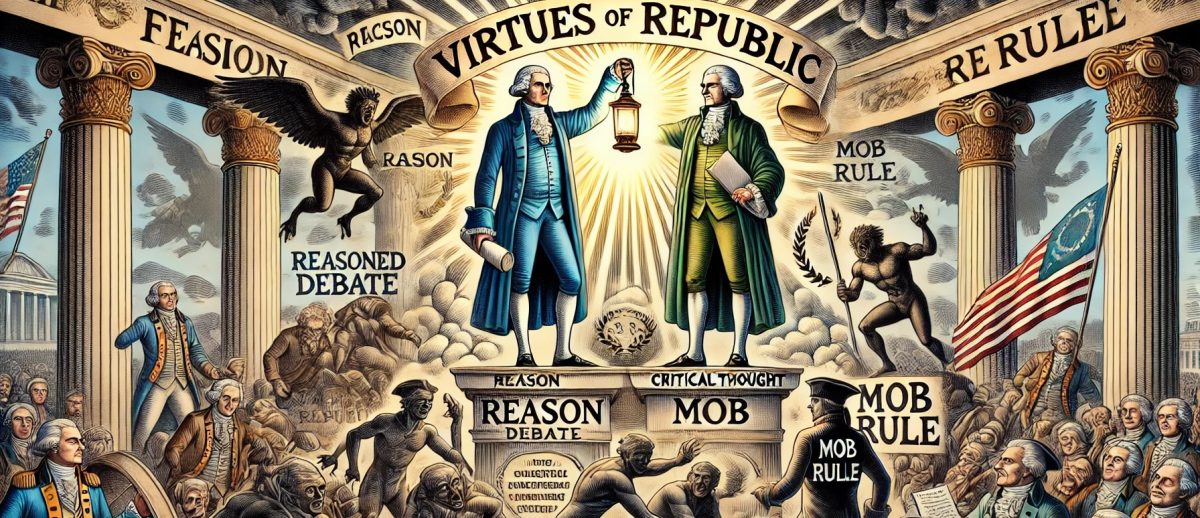
The machinery of government when the U.S. Constitution was drafted by James Madison and others looked something like this:

It looks peaceful enough, but things went awry almost from the beginning.
The first formal vote by Virginia colonists was after the Susan Constant, Godspeed, and Discovery arrived at the Chesapeake Bay.
The London Company had appointed Christopher Newport as the commander of the three-ship expedition that left London in December 1606 and carried over 100 people planning to live permanently in Virginia, but Newport would return home and others would govern the colony after arrival. Once the ships reached Virginia, the sealed box with the names of the new leaders was opened.
The company’s instructions appointed John Smith as one of the seven people on the council that would govern the colony, but the other appointees immediately decided to block him from participating. Smith had been locked up for most of the journey across the Atlantic Ocean. Evidently he was not very gentle when expressing his point of view, and others on the ships were not experienced at working together as members of a team. Captain Newport even proposed to hang Smith while the expedition sailed through the Caribbean before turning north to reach Virginia in April, 1607.
Because Smith was blocked from participating in the first vote to choose a President of the Council, voter suppression began at the very start of colonization in Virginia. Smith was added to the council with the right to vote before Captain Newport sailed home in June, 1607, but the Council remained a dysfunctional group of leaders.
There was voting in Virginia from the beginning of English settlement, but the number of voters was always tightly constrained. Only existing members of the Council (or company officials in London) could select new members of the Council; the other colonists had no ability to choose their leaders. Only members of the governing council, or the political/military leaders later appointed by the company, were authorized to vote on managing the colony until the company created a representative assembly in 1619.
Two months after Newport returned to England, half the colonists were dead or dying. The members of the Council accused their President, Edward Maria Wingfield, of hoarding food. By a vote of the council, Wingfield was deposed.
Madison was a Virginian, and he would have known these events and others that unfolded over the century and a half between the founding of Jamestown and the constitutional convention in 1787. He would have known about human nature and the fragility of decision-making to balance competing interests and beliefs. Yet the constitution is nearly silent on how democracy works. Article One, Section Four says it is up to the States to decide. And that is all.
But that is not all we know about how democracy is supposed to work. Madison, Alexander Hamilton, John Jay (and probably others) pored over the roadmaps that have taken us from colonial Virginia to these times–which everyone seems to believe are times of unique peril–and told us what they were thinking.

We know considerably less about what these people are thinking:

Federalist Paper No. 10 is about factions—groups of individuals united by a common interest or passion adverse to the rights of others. Madison says factions are inevitable due to human diversity, especially in opinions, wealth, and property. It is also about information: since factions are unavoidable, accessibility to information that expands the public sphere is the only way to control them in a democracy. Complex rules and technology undermine society’s access to information. Opacity, misinformation, disinformation, and unaccountable power are the great threats. Madison’s spirit haunts the present.

TO W. T. BARRY. MAD. MSS.
Aug 4, 1822
Dr Sir, I recd. some days ago your letter of June 30, and the printed Circular to which it refers.
The liberal appropriations made by the Legislature of Kentucky for a general system of Education cannot be too much applauded. A popular Government, without popular information, or the means of acquiring it, is but a Prologue to a Farce or a Tragedy; or, perhaps both. Knowledge will forever govern ignorance: And a people who mean to be their own Governors, must arm themselves with the power which knowledge gives…
Check back with us soon as we discuss how the ideals of Democracy have been undermined by complex rules and technologies that neither policymakers nor technologists fully understand. As James Madison–author of Federalist 10 — said, a government without accessible information is a “prologue to a farce or a tragedy.”